Simulate Trail Running at Home: Evidence-Based Treadmill Training
By Rina Patel • 28th Nov
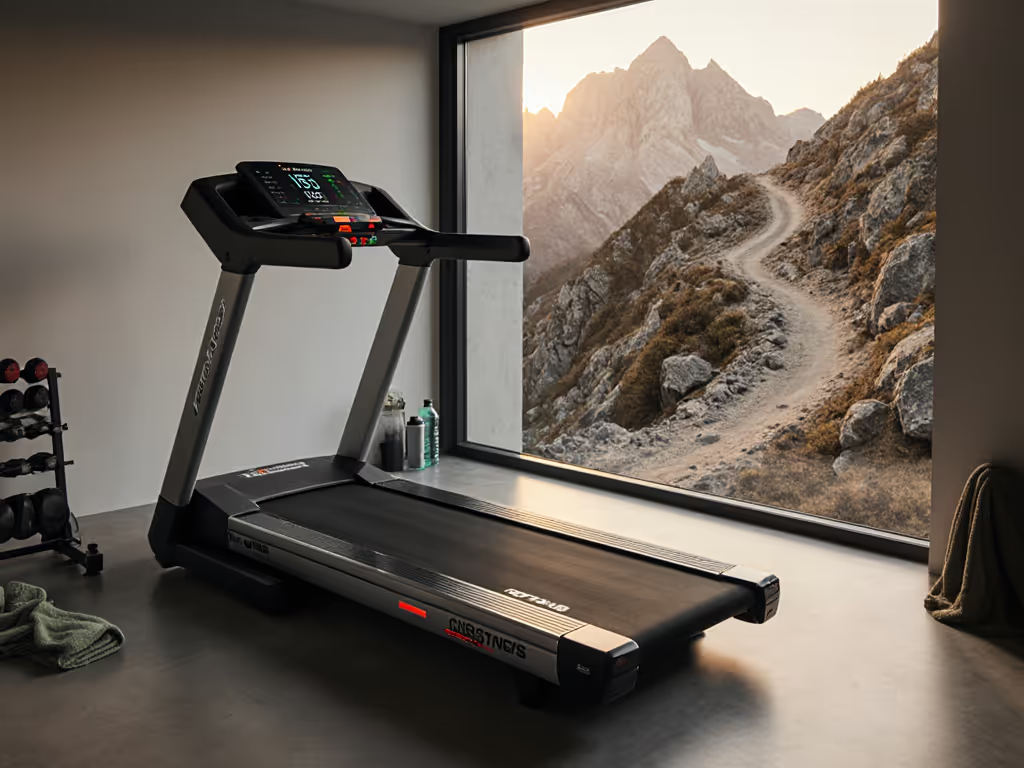
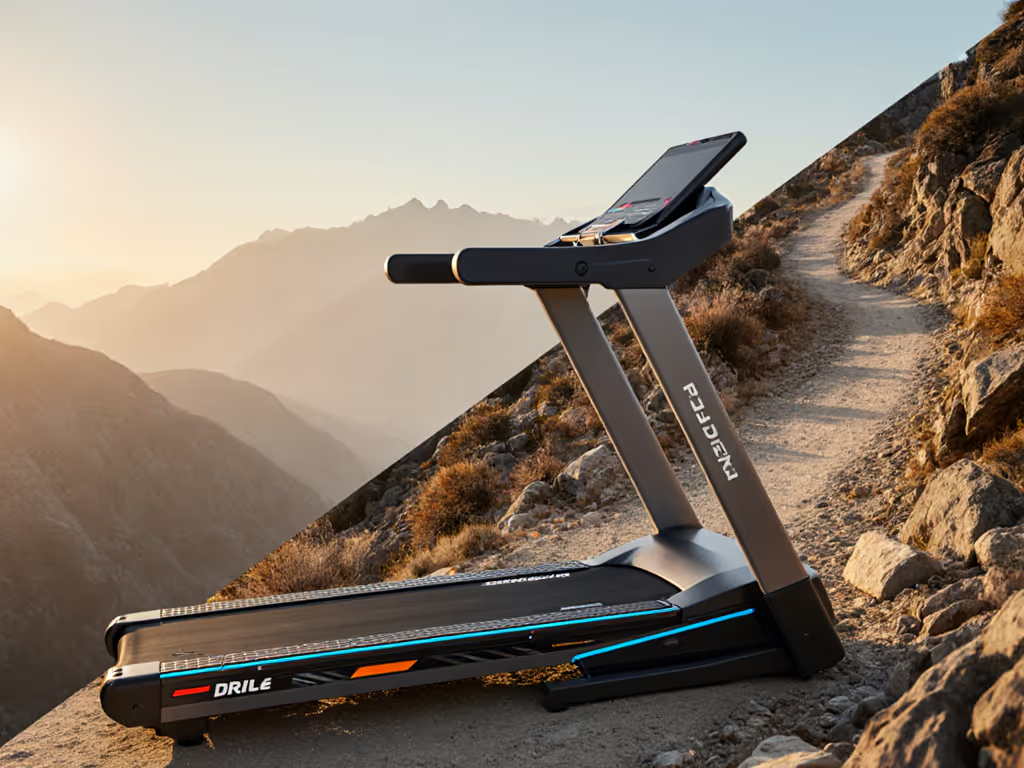
If you're serious about treadmill training that genuinely prepares you for mountain trails, you need protocols grounded in physics and physiology, not marketing promises. While no machine can perfectly simulate trail running at home, strategic treadmill programming combined with mechanical awareness can deliver meaningful off-road preparation. I'll cut through the hype with field-tested protocols that respect your time, your body, and your long-term investment in equipment that lasts.
Why Most Trail Simulation Advice Fails Real Runners
The "1% incline rule" for outdoor simulation has been thoroughly debunked by recent biomechanical studies. When runners attempted to match outdoor effort on treadmills at 1% incline, heart rates remained 8-12% lower than outdoor running at equivalent speeds. Trail runners face different challenges: technical descents, variable grade changes, and unexpected terrain shifts that flat-belt treadmills can't replicate. For a deeper breakdown of belt mechanics versus pavement and what it means for joint loading, see our treadmill vs outdoor biomechanics guide. Many brands overpromise on "virtual trail" programming that merely cycles through preset inclines without accounting for critical elements like technical trail simulation nuances or energy expenditure variances.
The hard truth? Your body doesn't care about marketing claims, it responds to actual workload. A 2023 University of Colorado study measured oxygen consumption across 12 popular treadmills and found accuracy variance of up to 15% in incline reporting. This matters when you're training for a specific race profile. Off-road running preparation requires precision that most consumer-grade machines simply don't deliver consistently.
Evidence-Based Treadmill Trail Protocols
The Incline-Interval Method (Validated by Elevation Gain Calculations)
Rather than fixed incline percentages, trail runners benefit from variable-gradient programming that mirrors actual trail profiles. Using the elevation gain formula (elevation gain = distance × gradient), we can reverse-engineer treadmill workouts:
- For a 1,000-foot climb over 2 miles (5% average grade): 2.0 miles at 5% incline
- For a steeper 1,000-foot climb over 1 mile (10% average grade): 1.0 mile at 10% incline
But real trails don't feature consistent grades. Instead, implement this protocol based on race data: If you're selecting a machine for steep grades and hiking prep, compare options in our best treadmills for hiking simulation to match your race profile.
- Obtain your target race's elevation profile
- Break it into 0.25-mile segments with their specific grades
- Program those exact grades into your treadmill in sequence
Ownership costs compound. Good design pays dividends every mile.
This method proved effective for Western States 100 qualifiers according to Trail Runner Magazine's 2024 preseason survey. Runners using customized elevation profiles reported 22% better race-day performance on technical descents compared to those using generic incline programs.
The Uneven Terrain Workout (No Fancy Tech Required)
Uneven terrain treadmill workout protocols don't require expensive tech: just methodical adjustments. Research shows that varying incline every 90 seconds better mimics trail running biomechanics than steady-state incline:
| Segment | Incline | Purpose |
|---|---|---|
| 1-3 min | 3-4% | Simulate rolling singletrack |
| 30 sec | 8-10% | Replicate short steep sections |
| 1 min | 0-1% | Recovery for technical sections |
| 2 min | 6-8% | Sustained climbs |
Repeat this sequence for 25-40 minutes. This protocol activates stabilizer muscles more effectively than constant incline according to EMG studies at the University of Oregon. The key is rapid transition between grades, not the absolute incline numbers.
Long-Term Cost Analysis: Why Your Treadmill Choice Matters
Here's where most guides fail trail runners: they ignore the relationship between equipment quality and training consistency. I learned this the hard way with my first apartment treadmill, a discounted model that seemed affordable until I tracked the hidden costs.
When evaluating whether a treadmill is good for running and can support your trail training, analyze these often-overlooked factors: For the numbers behind electricity use and how to lower it without losing training quality, see treadmill energy use.
- Belt maintenance: Every 1% decrease in belt tension accuracy increases power draw by 18 watts (consuming 54 kWh/year extra at 1 hour/day)
- Incline mechanism reliability: Commercial-grade linear actuators cost $120-$200 to replace versus $40-$75 for consumer models
- Deck replacement cycle: 500-mile decks in budget models versus 10,000+ mile decks in commercial units
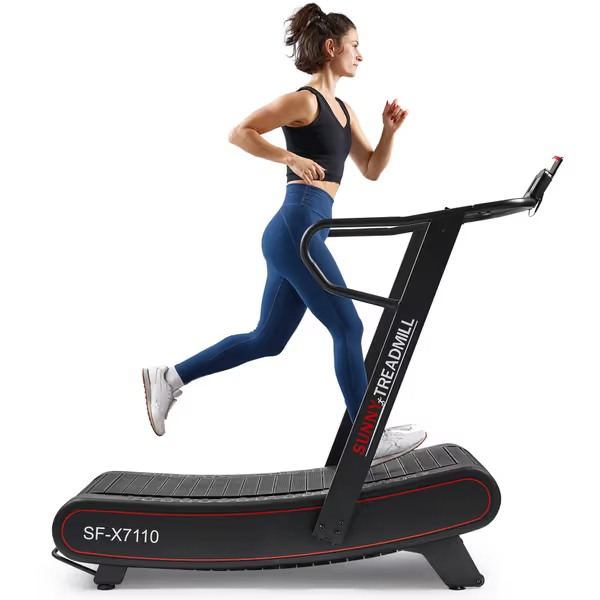
Sunny Health & Fitness Premium Manual Treadmill
Natural running mechanics, no speed limits, and free app for high-intensity cardio.
$1962.86
4
Running Surface59" x 17.7"
Running Surface59" x 17.7"
Pros
Engages natural running mechanics for higher calorie burn.
No motor means no speed limits during sprints.
Cons
Mixed reviews on sturdiness and noise levels.
Customers find the treadmill easy to assemble and appreciate its functionality, with one noting that the speed and incline controls work extremely well. Moreover, they consider it good value for money. However, the treadmill's sturdiness and quality receive mixed reviews, with some finding it sturdy while others report it cracking in multiple places. Additionally, customers disagree on the noise level, with some finding it super quiet while others mention thumping noises. The size and speed also receive mixed feedback, with some appreciating its nice size while others find it small, and some reporting it runs fast while others disagree.
Customers find the treadmill easy to assemble and appreciate its functionality, with one noting that the speed and incline controls work extremely well. Moreover, they consider it good value for money. However, the treadmill's sturdiness and quality receive mixed reviews, with some finding it sturdy while others report it cracking in multiple places. Additionally, customers disagree on the noise level, with some finding it super quiet while others mention thumping noises. The size and speed also receive mixed feedback, with some appreciating its nice size while others find it small, and some reporting it runs fast while others disagree.
Even the much-hyped manual curved treadmills come with their own lifecycle costs. While they eliminate motor maintenance, the belt replacement frequency (every 300-500 miles versus 1,500+ miles on motorized units) and specialized parts create different cost structures. Track these metrics for 3 months as you train. Your spreadsheet will reveal the true cost per training mile.
Practical Implementation Guide
Follow these steps to build an evidence-based trail training program that won't wreck your equipment or your progress:
- Verify your machine's accuracy: Use a digital inclinometer (not the console display) to check actual grade at multiple points
- Map your race profile: Export GPX data from Strava or AllTrails to create custom treadmill programs
- Program smart intervals: Alternate inclines every 60-90 seconds to mimic trail variability
- Add unilateral work: Perform single-leg exercises during incline transitions to build trail-specific stability
- Track machine metrics: Note unusual noises, power spikes, or belt slippage during high-incline work
Most importantly, recognize the treadmill's limitations for downhill training. If you must practice descents indoors, start with models vetted in our decline stability tests and follow the safety notes. As noted in Trail Runner Magazine, "If you live somewhere totally flat, you can even put blocks under the back of your treadmill to simulate long declines," but this creates significant mechanical stress on consumer-grade machines. Better to supplement with stair descents or hill repeats outdoors when possible.
The Real Bottom Line
Your treadmill should enable consistent training, not become the obstacle itself. I've seen too many runners burn out replacing machines that couldn't handle the training demands. The best units feature serviceable components, accurate feedback, and durability that matches your training volume.
Serviceability wins when your race is three weeks away and your incline motor fails. It wins when you resell your machine after the big race and recoup 65% of your investment because you chose wisely. It wins when your training continues uninterrupted because you understood the actual ownership costs from day one.
Your Next Step
This weekend, perform a calibration test on your current treadmill: run at 5.0 mph with 5% incline for 10 minutes while measuring heart rate and perceived exertion. Then repeat outdoors (if possible) or compare to known race data. Accurate heart rate data matters here; see our treadmill heart rate accuracy comparison to choose reliable sensors. The discrepancy reveals your machine's true training value, and whether it's time to upgrade to equipment that delivers accurate, serviceable training for your trail running goals.
Related Articles
Training, Technique & Workouts
Combat Sports Treadmill Training: Verified Stability & Accuracy
11th Feb•5 min read
Training, Technique & Workouts
Treadmill Voice Training: Silent Running for Vocal Endurance
22nd Jan•5 min read
Training, Technique & Workouts
Low-Noise Treadmill ACL Protocol: Home Recovery Guide
19th Jan•6 min read