
Training, Technique & Workouts
Marathon on Treadmill: Protocols for Your First 26.2
23rd Mar•7 min read
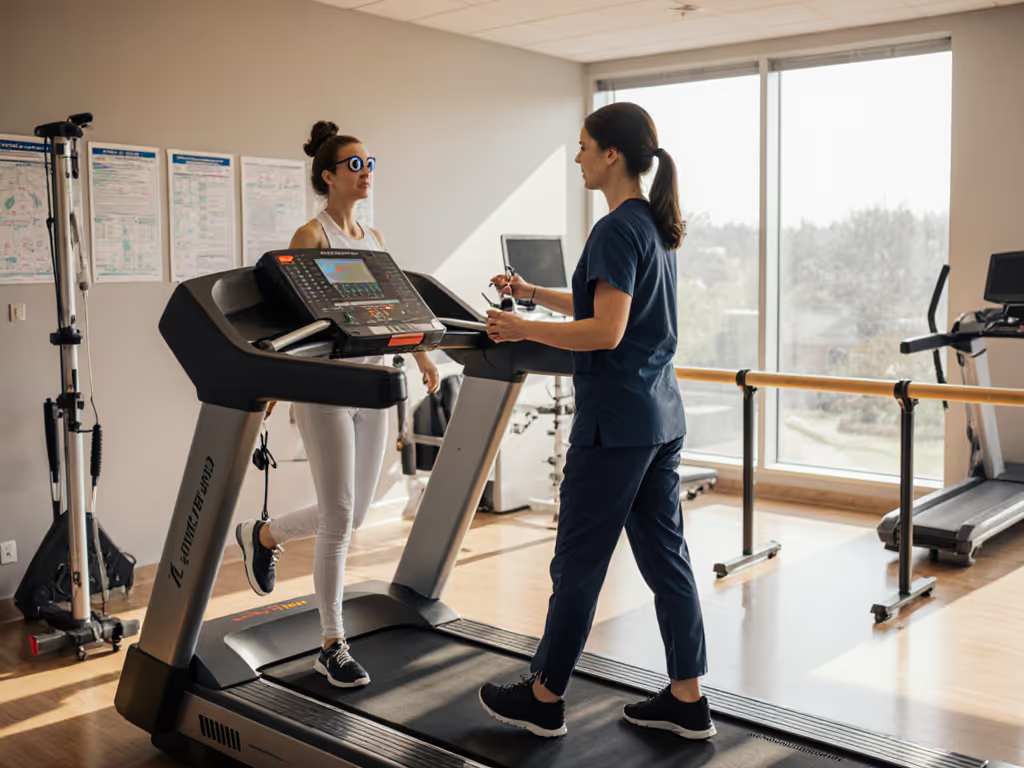
Treadmill vestibular rehabilitation combines controlled walking on a motorized treadmill with structured exercises designed to retrain balance and reduce dizziness in people with vestibular dysfunction.[1][3] Unlike generic balance therapy conducted in a clinic, treadmill-based balance disorder protocols layer progressive physical demands (changing speed, incline, and cognitive load) in an environment where you can safely fall and where measurable data informs progression. Before starting, review our treadmill safety tips to reduce fall risk during vestibular work. This matters because vestibular recovery is not passive; it demands consistent, repeatable challenge three times daily or more, and a treadmill removes guesswork from dosing.
But here's the practical truth: a treadmill is a tool that must pay for itself through reliable use. Before adopting treadmill-based vestibular therapy, you need to understand what the research actually supports, what equipment demands, and how to avoid converting a one-time rehabilitation win into a thousand-dollar closet fixture.
Vestibular rehabilitation therapy (VRT) operates on three core recovery mechanisms: adaptation (the brain learning to compensate for vestibular loss), substitution (vision and proprioception stepping in), and habituation (repeated exposure to movements that trigger dizziness gradually erasing the trigger).[3] The treadmill accelerates this process because it allows you to repeat movements in precise, measurable doses. A stride pattern cannot vary as much on a motorized belt as it does on the ground or in a clinic, and you can track walking speed and incline to quantify progression.
The key advantage of treadmill-based vestibular therapy exercises is multidimensional tasking: walking at a specific pace while turning your head, fixing your gaze on a moving target, or performing a cognitive task (counting backward, mental arithmetic) simultaneously.[2] This mirrors real-world demands and prevents the patient from collapsing into compensatory patterns that feel safe but do not retrain the vestibular system. Research documenting a military aviator recovering balance function after weeks of treadmill therapy with platform motion found that combined walking and multitasking produced a 200% improvement in virtual-environment balance scoring over six weeks, and critically, the patient returned to full duty.[2] This was not a marketing claim; it was documented across six therapy sessions with measured walking speed progression and task difficulty escalation.
Three primary VRT approaches have been formally compared: customized vestibular rehabilitation (CVRT, tailored to individual deficits), generic Cawthorne-Cooksey exercises (GVRT, a standard historical protocol), and vestibulo-ocular reflex (VOR) adaptation exercises.[1] In a multicenter pilot trial with 23 patients completing an 8-week protocol performing exercises three times daily, all three groups showed statistically significant improvement in balance measures, dizziness ratings, and daily function, but no statistically significant difference between groups.[1] The customized group trended toward the largest numerical gains, but the difference did not reach statistical significance.
What this means in plain terms: the research does not prove that treadmill training beats other methods, nor does it show one treadmill protocol as superior to another. Instead, it confirms that consistent, progressive, repeated exercise works, and the specific method matters less than adherence and progressive loading. Ownership costs compound (good design pays dividends every mile), and that principle applies here: a treadmill worth using is one you will actually use, maintain, and afford to power.
If you are implementing a treadmill for dizziness management at home, the framework is straightforward but demands discipline:
Exercise frequency and duration: Perform prescribed exercises a minimum of three times daily.[3][5] Each session need not be lengthy (research suggests even brief, frequent bouts are sufficient if they are genuinely performed daily). Realistically, expect 20 to 30 minutes per session if you are combining walking, head-eye movements, and cognitive load. This is not a marathon; it is consistency.
Speed and incline progression: Begin at a comfortable walking pace, typically 1.2 to 1.5 m/s (2.7 to 3.4 mph), and increase walking speed incrementally as balance improves and dizziness diminishes.[2] Incline adds proprioceptive demand; some patients find it easier to progress incline before speed. The treadmill must report verified speed accuracy and incline accurately. Marketing specifications often quote peak power, not actual belt speed stability; if your treadmill drifts ±0.1 mph during walking, your protocol dosing is compromised, and you will not know it.
Multitasking layer: Once walking is stable, layer cognitive or visual tasks: counting, mental math, or tracking a moving target while walking. This forces substitution and prevents over-reliance on vestibular compensation, and creates a real-world-fidelity challenge that walking alone does not.
Gaze stability component: Head-eye movements performed while walking (scanning side to side, nodding up and down, rotating your head while focusing on a fixed target) are foundational.[3] The treadmill's consistent speed allows you to repeat these movements safely without losing footing.
Treadmill vestibular therapy works only if the machine remains in service. Here are the non-negotiable durability points:
Motor efficiency and runtime: A treadmill running 90+ minutes per day (three sessions of 20 to 30 minutes) is under continuous load. A 3.0 HP continuous-duty motor (not peak) is the baseline; anything less will overheat or throttle under repeated daily use. Check the manufacturer's duty cycle rating (the percentage of time the motor is designed to run continuously) and corroborate it with real user reports at high daily mileage. A motor rated for casual use will fail within 12 to 18 months of therapy-level demand.
Belt and deck durability: VRT often involves repeated walks at the same cadence and footfall pattern, which accelerates wear in localized zones of the belt and deck. A polyurethane or reinforced-rubber deck rated for 3,000+ miles of use (not theoretical; actual stress-tested data) is necessary. Belts degrade from friction, moisture, and UV exposure; standard replacements run $400-$800, and if your treadmill's deck is integral to the frame, replacement labor costs double the part cost. I tracked kWh, lube intervals, and parts prices on my first machine until I understood the total cost over time, and those tracking sessions revealed that a seemingly discounted treadmill would have demanded $2,000 in maintenance and parts before its fifth year.
Lubrication and maintenance accessibility: Treadmill decks require periodic lubrication (typically every 3 to 6 months under daily use). If the machine requires disassembly or professional servicing for routine maintenance, you will either skip maintenance (accelerating bearing wear) or incur recurring service fees ($150-$250 per visit). Machines with accessible lubrication ports and clear intervals in the manual are non-negotiable for long-term cost control. Follow our belt lubrication guide to extend machine life between service visits.
Power efficiency: A 3.0 HP treadmill running 90 minutes daily consumes roughly 0.6-0.8 kWh per day, or 18-24 kWh per month.[3] At US residential rates (~$0.14/kWh), that is $25-$34 per month in electricity ($300-$408 per year). Over a 5-year protocol or recovery period, expect $1,500-$2,000 in energy cost. A machine with a certified TEFC (totally enclosed, fan-cooled) motor and variable-frequency drive (VFD) control will drop that by 15-20%. For detailed ways to cut operating costs, see our treadmill energy use guide.
If you are considering treadmill-based balance training treadmill protocols for vestibular recovery:
Validate the protocol with your healthcare provider or vestibular physical therapist. Confirm that treadmill training addresses your specific deficit (unilateral or bilateral vestibular hypofunction, post-BPPV, or other diagnosis). Not all vestibular disorders benefit equally from treadmill-based therapy; central lesions or severe migraine-related dizziness may require different approaches. Get the exercise prescription in writing: speed, incline, duration, frequency, and progression timeline.
Document baseline metrics before starting. Measure your natural walking speed on level ground without the treadmill, your balance confidence on a standard clinical test, or your dizziness rating on a validated scale (Dizziness Handicap Inventory or Vertigo Symptom Scale). These benchmarks let you quantify improvement and adjust the protocol if progress plateaus.
Select a treadmill designed for daily use, not occasional weekend walking. Prioritize continuous-duty motor rating, actual (not peak) horsepower, user weight capacity matched to your body mass plus a safety margin, and a belt length of at least 55 inches to accommodate your natural stride. Request the manual before purchase and confirm that lubrication intervals, belt replacement cost, and motor warranty are all documented and reasonable.
Establish a maintenance schedule. Set a calendar reminder for lubrication every three months, motor filter cleaning every six months, and belt alignment checks monthly. These small acts prevent cascading failure and keep your total cost over time predictable.
Track adherence and progression systematically. Use a simple spreadsheet: date, time of session, speed, incline, duration, any dizziness or loss of balance, and a brief note on how you felt. This record justifies the machine's cost, informs your therapist's adjustments, and provides motivation, and watching speed and duration improve over weeks is tangible proof that the rehabilitation is working.
Vestibular recovery is real and measurable, but only if the tool you choose is reliable enough to support three months, six months, or a year of daily use. The best treadmill is the one you can maintain, afford to run, and resell when your vestibular function has recovered enough to move forward.