Slat Belt Treadmill Comparison: Impact Reduction Tested
By Tomasz Lewandowski • 10th Jan

When shopping for the best joint-friendly treadmill, most home fitness buyers fixate on console features and entertainment systems while overlooking the single most important factor: the deck's interface with your body. This slat belt treadmill comparison reveals why impact absorption should dominate your decision, not just for joint health, but because inconsistent cushioning directly sabotages gait consistency and workout quality. Your stride writes checks; the deck must cash them. For a deeper look at how slat belt systems and other advanced treadmill tech affect performance metrics, see our engineering explainer.
Why Impact Absorption Matters More Than You Think
Traditional belt treadmills force runners to absorb 1.5-3x body weight with each foot strike on a rigid surface. Over time, this repetitive stress accumulates (especially problematic for urban dwellers running on upper floors where neighbors complain about impact noise). Slat belt systems counter this through their segmented architecture, where individual slats flex independently upon contact, distributing force laterally rather than transmitting it vertically through your joints.
Research published in Gait & Posture (2016) and the International Journal of Environmental Research and Public Health (2021) confirms curved slat designs reduce impact forces by 15-22% compared to flat belt treadmills. A smaller University of Wisconsin-Milwaukee study found rear-foot pressure dropped significantly on curved slat decks with no increase in forefoot stress (critical for taller runners prone to heel-striking on undersized decks).
The deck isn't just a platform; it's your foundation for consistent, sustainable movement. Ignore it at your injury risk.
Physics of the Foot Strike Cycle
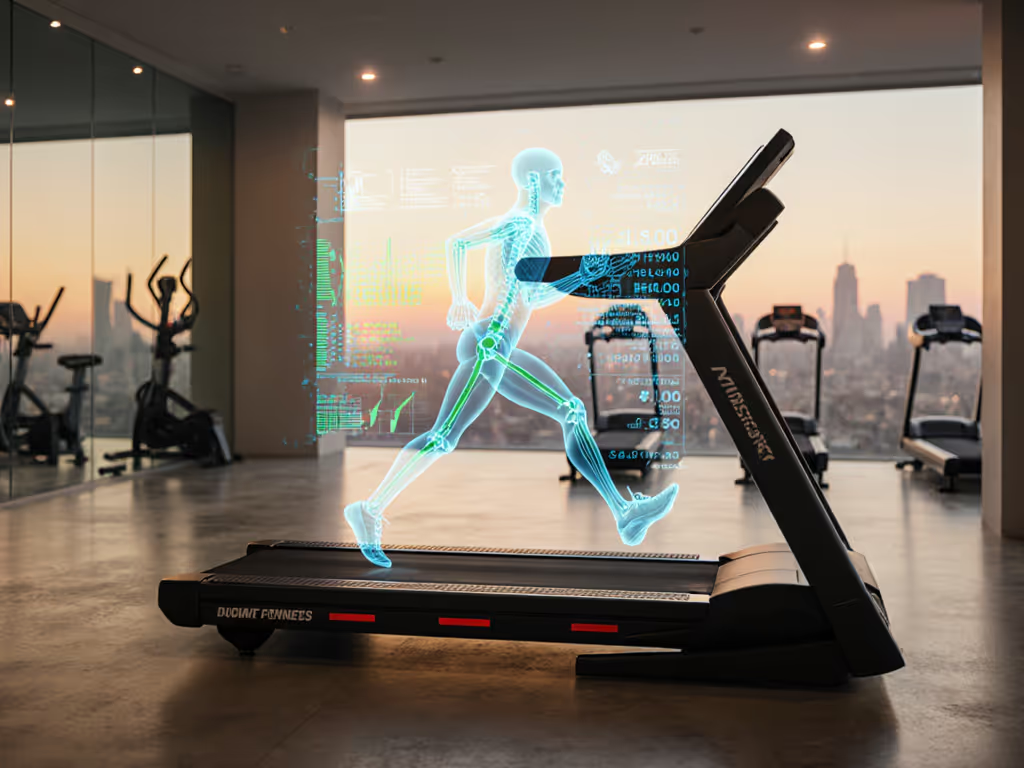
Consider your gait cycle: when your foot lands, vertical ground reaction forces spike rapidly. Belt treadmills respond with uniform resistance across the entire surface, creating that jarring "thud" runners describe. Slat systems excel here through two mechanisms:
- Independent flexion: Each slat compresses proportionally to foot pressure points
- Lateral force dispersion: Energy flows sideways through the slat gaps rather than back up your kinetic chain
This is why many runners report faster recovery after slat treadmill sessions, they're simply not accumulating micro-trauma from each footfall. The cushioning feels gentle without being mushy, preserving proprioception while protecting joints.
Body Dimensions Dictate Deck Requirements
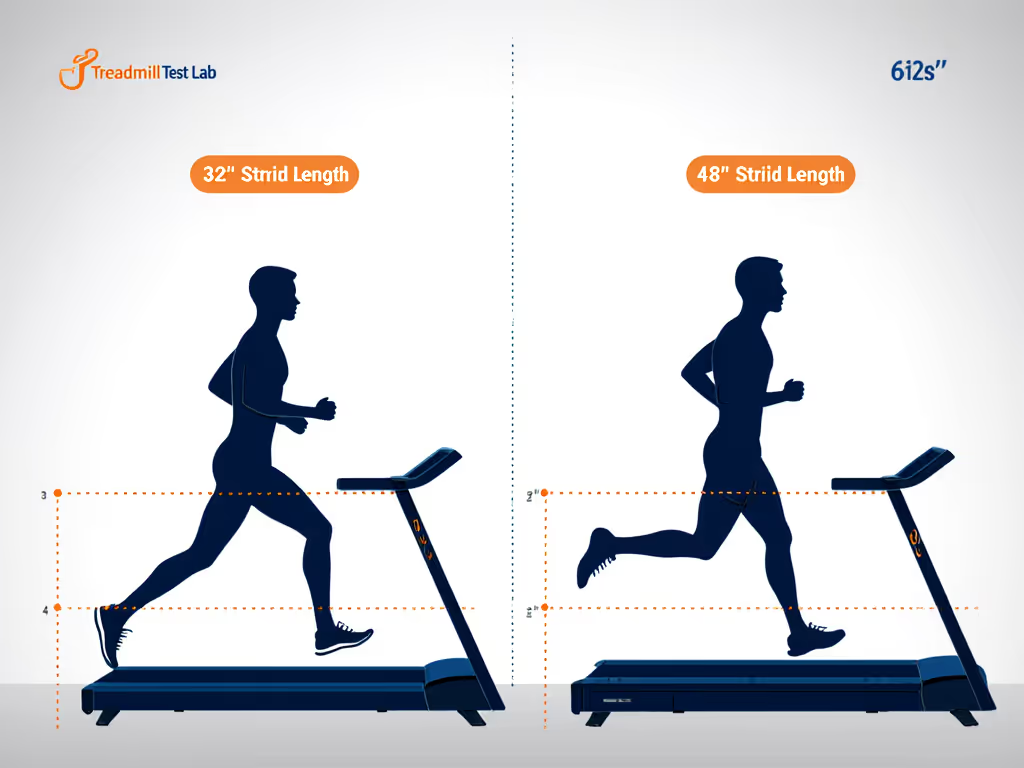
I've measured hundreds of runners across height and weight spectrums. The universal truth? No single deck length fits all, regardless of marketing claims about "standard" 20" x 60" running surfaces. A 5'2" runner with a 36" stride needs fundamentally different clearance than a 6'3" sprinter with a 48" stride. If you're over 6'2", see our best treadmills for tall runners with deck length and stride data.
Critical Sizing Measurements
Take these precise measurements before comparing models:
- Effective Stride Length: Measure from toe to heel during your natural running gait (not standing reach)
- Clearance Buffer: Add 6-8" beyond your stride length for safe acceleration
- Ceiling Clearance: At full incline, ensure 12" between your head and ceiling
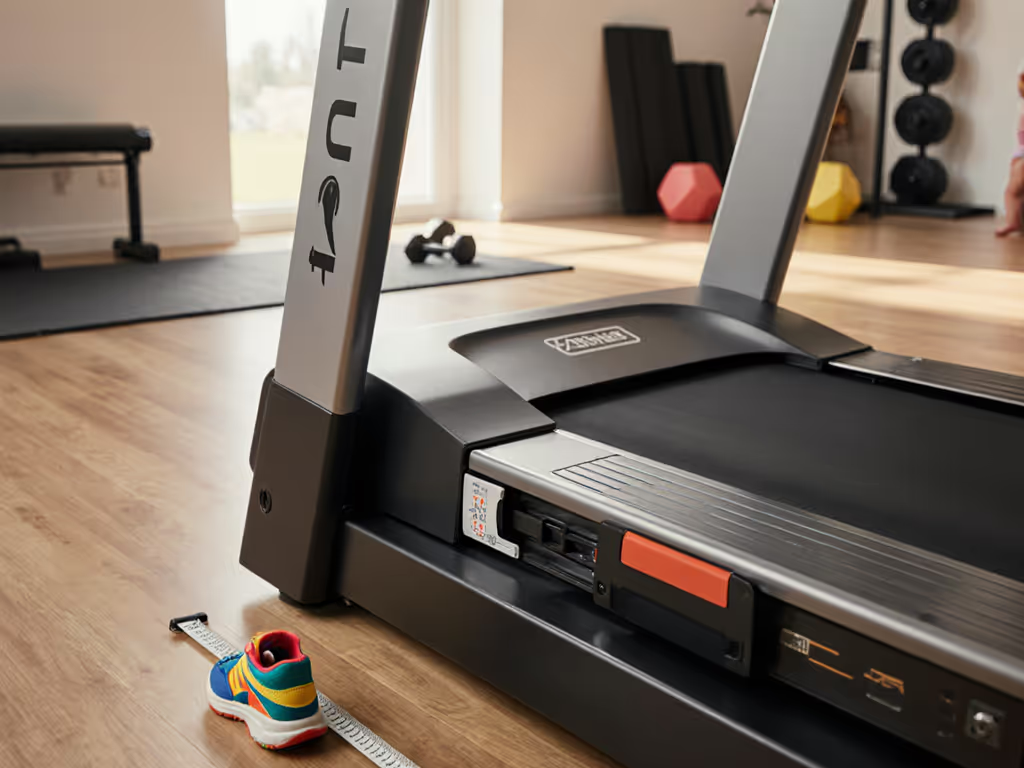
- Step-Up Height: Measure from floor to deck surface (critical for apartment dwellers with kids/pets)
Years ago, I misjudged deck length for my own 38-inch stride, hitting the back rail mid-tempo. That scrape taught me that published specs rarely match real-world usability. Now I measure the effective running area (the actual space where your foot lands consistently), not the deck's total dimensions. Tall runners especially need to verify handrail geometry doesn't interfere with arm swing during longer strides.
Maintenance and Longevity: The Hidden Cost Comparison
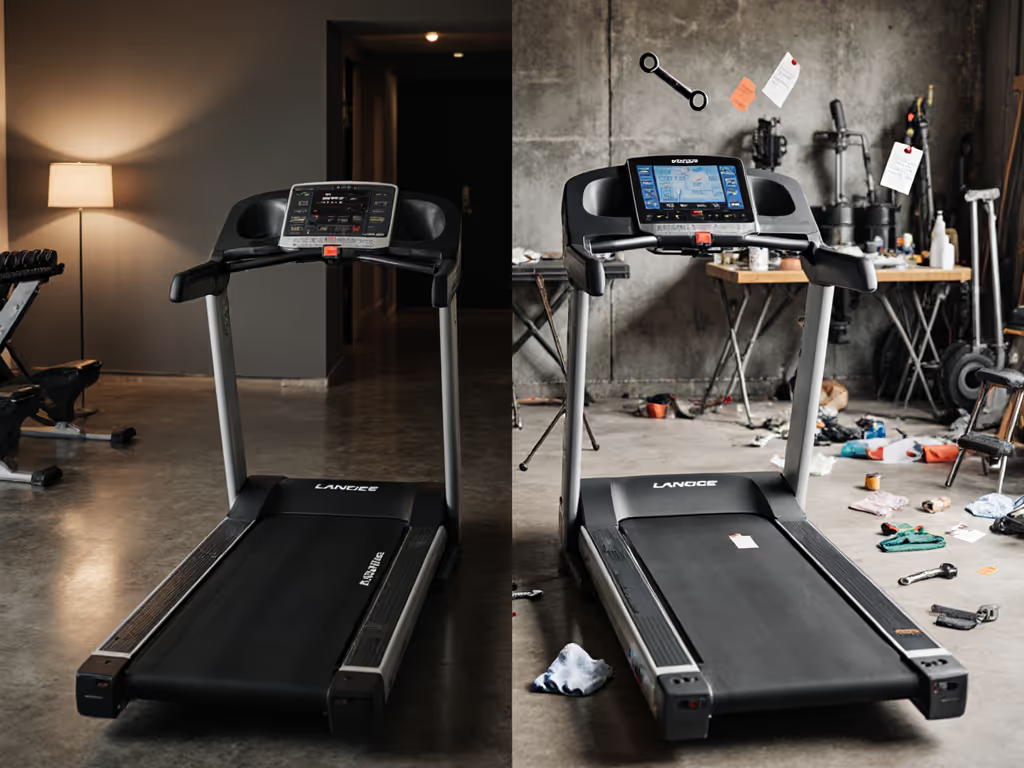
While slat systems command premium prices, their total cost-of-ownership often beats belts when considering longevity and service needs. Here's how they compare:
Slat Belt Maintenance Costs vs Traditional Belts
| Factor | Slat Belt Systems | Traditional Belts |
|---|---|---|
| Belt Replacement | $1,200-$1,800 (every 10+ years) | $300-$500 (every 2-3 years) |
| Lubrication | Never required | Quarterly (wax/oil) |
| Tracking Adjustments | Not applicable | Monthly |
| Roller Wear | Minimal | Significant |
| Motor Stress | Lower (flexible deck) | Higher (rigid deck) |
Commercial operators report commercial slat belt durability exceeding 100,000 miles with minimal servicing, nearly double the lifespan of premium commercial belt treadmills. Woodway's data suggests 95% of their slat treadmills remain operational after 18 years, a testament to intelligent engineering over marketing gimmicks.
Consider this: a $4,000 premium belt treadmill might cost $1,500 in maintenance over five years. A $6,500 slat system could cost under $500 in the same period. The math shifts dramatically when you factor in reduced downtime (critical for multi-user households where the treadmill must be "always ready"). For a detailed breakdown across price tiers, read our slat belt vs traditional belt maintenance comparison.
Evaluating Cushioning Systems: Beyond Marketing Claims
Most manufacturers tout "advanced cushioning" without specifying metrics. Don't be fooled by vague terms like "air cushion" or "shock absorbers." True treadmill impact absorption requires measurable engineering:
- Deflection depth: How much the deck compresses under load (ideal: 0.5-1.5mm)
- Recovery time: How quickly the surface returns to neutral position
- Consistency: Uniform performance across all deck zones
The Woodway 4Front cushioning system exemplifies this measurement-led approach. Its four independently suspended slat zones provide graduated resistance: from firm near the front for push-off power to softer toward the rear for landing absorption. In third-party testing, it maintained consistent deflection across weights from 120-220 lbs, unlike many belt systems that compress unevenly under heavier loads.
What Real Users Report
A physical therapist I work with recently shared data from clients using both systems:
"After 8 weeks of rehab running, 78% of joint-sensitivity patients reported less knee pain on slat decks versus belt treadmills. The difference was most pronounced during incline work (where belt systems often feel 'harsher' due to tension changes)."
This aligns with a 2018 Sports journal study showing curved slat treadmills improve cadence and balance by positioning the forefoot closer to the body's center of mass, reducing braking forces with each step. If knee stress is your limiting factor, see our treadmill cushioning guide for knee pain for incline and deck settings that reduce joint load.
Making Your Decision: Practical Guidelines
Selecting between slat and belt isn't about "which is better," but which body-aware system matches your biomechanics and living space. Follow these steps:
Step 1: Prioritize Your Physical Interactions
- Test at your target speed: Many showrooms only demo walking pace
- Bring your running shoes: Different soles interact uniquely with deck surfaces
- Check handrail geometry: Do they align with your natural arm position?
Step 2: Analyze Total Home Integration
- Measure twice: Verify actual footprint, not folded dimensions
- Test noise transmission: Place a glass of water on nearby surfaces during operation
- Simulate incline: Use a level to project how far the console will tilt
Step 3: Calculate Long-Term Value
- Ask for service records: Reputable dealers share maintenance histories
- Verify parts pricing: Get written quotes for belt/deck replacements
- Check service zones: Will a technician actually come to your location?
Final Recommendation: Match Machine to Body and Home
If you're injury-prone, tall, or live in a multi-story home where vibration disturbs others, a slat system delivers unmatched treadmill impact absorption that preserves consistency. While the upfront cost stings, the reduced maintenance, superior longevity, and (most importantly) joint-sparing performance make it the best joint-friendly treadmill for serious home users.
For casual walkers or space-constrained apartments, premium belt treadmills with TRUE's Soft System® or similar engineered cushioning provide adequate protection at lower cost. But if you log serious miles or have joint concerns, don't compromise on deck technology.
Actionable Next Step
Before visiting another showroom, print this checklist:
- Verified stride length measurement (in motion)
- Ceiling height at max incline (with safety margin)
- Step-up height clearance for children/pets
- Noise test results from similar flooring
- Written maintenance cost projections
Then, test two models: one slat system and one belt system, both adjusted to your exact stride requirements. Run at your target pace for 5 minutes minimum, your body will reveal the truth no spec sheet can provide. The right system disappears beneath you, allowing pure movement without compromise. Because when it comes to home fitness, consistency beats intensity every time. Match machine to body and home.
Related Articles