Training, Technique & Workouts
Treadmill Vestibular Rehabilitation: Evidence-Based Protocols
31st Mar•8 min read
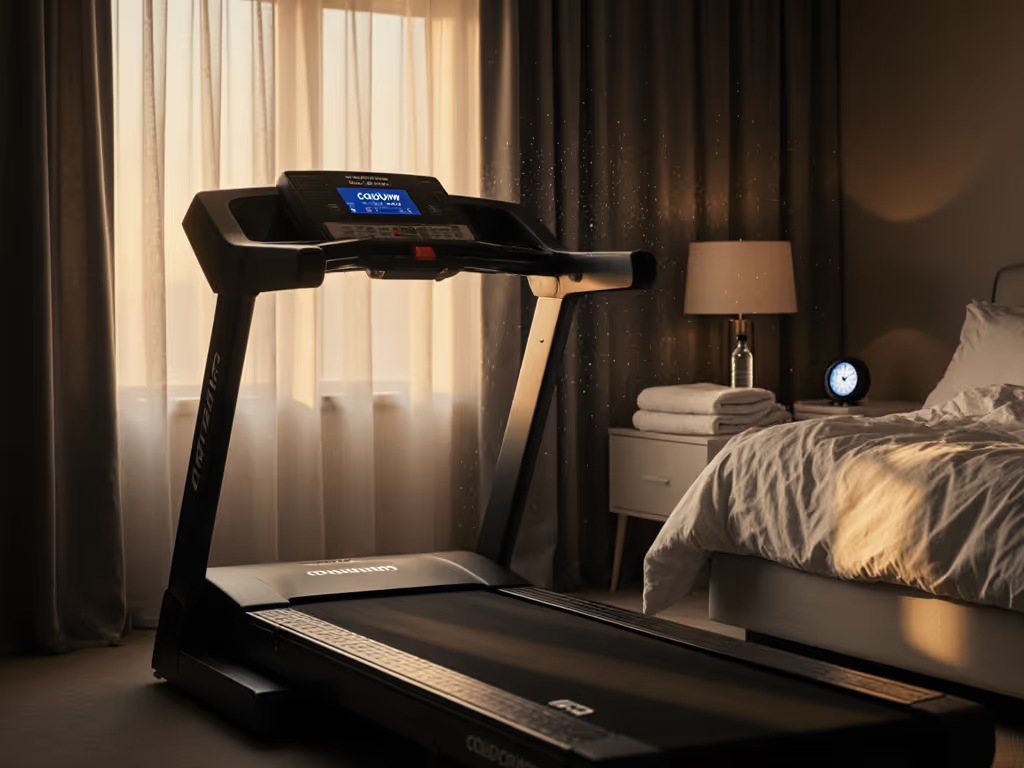
Treadmill sleep quality improvement isn't about crushing yourself into exhaustion. For step-by-step timing and intensity playbooks, see our treadmill sleep protocols guide. It is about the right dose of exercise at the right time, grounded in what actually moves the needle on deep, restorative rest. The research is clear: moderate aerobic activity improves sleep onset, duration, and quality, but the intensity sweet spot matters more than most people realize, as does the rhythm of how you layer these sessions into your weekly routine.
Exercise shifts your sleep architecture in measurable ways. When you perform moderate aerobic work (steady walking or jogging at a pace where you can still hold a conversation) your body increases the time spent in slow-wave sleep, the deep restorative phase where your nervous system genuinely decompresses[3]. This isn't mystical; it's neurochemical. Physical activity stabilizes mood, reduces cognitive noise, and helps your brain transition naturally into sleep[3]. One session of 30 minutes of moderate aerobic exercise can change sleep quality that same night[3].
The kicker: research consistently shows that moderate aerobic exercise is most effective for insomnia relief, while vigorous exercise (think all-out sprinting or resistance work) does not show the same sleep benefits[4]. This matters because many home exercisers assume harder equals better. It doesn't, at least not for sleep. The physiology works differently. Moderate intensity increases deep sleep duration and can help reset a misaligned circadian rhythm, especially if timed thoughtfully[4].
Over 4 to 24 weeks of consistent moderate aerobic training, participants with insomnia fell asleep faster, slept longer, and reported better overall quality than their non-exercising counterparts[4]. That's not hype, that's a dose-response relationship you can track.
Here's where most treadmill buyers miss the forest. Both moderate and vigorous exercise have cardiovascular benefits, but they affect sleep differently:
Moderate Aerobic (Most Sleep-Effective)
Vigorous Aerobic (Not Optimized for Sleep)
This distinction cuts directly to maintenance and machine wear. Learn core upkeep basics in our treadmill maintenance manual. A household running moderate-intensity sessions five times weekly experiences far less belt friction, motor strain, and stress on rollers than one punishing the deck with high-impact intervals daily. Over five to ten years, that difference compounds in bearing life, belt glazing, and electricity consumption. Ownership costs compound, and good design pays dividends every mile, and so does matching the machine's load profile to your actual training goal.
The honest answer: it varies by individual, and science hasn't fully pinned down a universal prescription[3]. But the research framework is useful.
Moderate aerobic activity performed in the morning or early afternoon can help reset your internal body clock, particularly if you struggle with delayed sleep onset[4]. For shift workers or people with naturally late chronotypes, a 30-minute treadmill session at 10 a.m. might anchor your rhythm earlier.
Evening treadmill sessions (2 to 4 hours before bed) are also well tolerated. If noise is a concern during late sessions, check our quiet treadmill for apartments guide for verified dB ratings and vibration tips. Studies on timing found that participants who exercised in the late afternoon experienced the same sleep benefits as those who worked out earlier, regardless of whether they used the treadmill in the morning or late afternoon[4]. The key is consistency and allowing a buffer period: finishing your session at least 2 to 3 hours before sleep gives your core body temperature time to drop, which signals sleep readiness.
If you're using a treadmill for insomnia, avoid high-intensity work within 3 to 4 hours of bedtime. The metabolic and neural stimulation from vigorous exercise can keep you wired. Moderate-intensity work is gentler, but listening to your own body remains essential. Some people sleep like stones after an evening walk; others need more wind-down time.
You don't need to log marathon hours. The floor is surprisingly low:
For a household buying a treadmill, this means a modest, consistent protocol works: walk or jog at steady state, 30 minutes, four to five times weekly. That's 120 to 150 minutes per week and fits into most schedules. Benefits appear quickly; you're not waiting months to see results[3].
From a machine perspective, that duty cycle also favors durability. A treadmill running moderate-intensity, 30-minute sessions is under far less thermal and mechanical stress than one subjected to daily high-intensity interval training. Motors cool better, belts last longer, and the deck doesn't prematurely soften.
Here's a framework aligned with what the data actually supports:
Foundation Protocol (4 to 5 days per week)
This hits the moderate-intensity zone, totals 30 to 35 minutes, and accumulates toward 150 minutes weekly. Perform it in the morning or early afternoon for rhythm alignment, or in the evening (finishing 2 to 3 hours before bed) for direct sleep support.
Variation Days (1 to 2 per week, optional)
Where treadmill-for-restful-sleep programs often hide their true cost is on the operational and maintenance side. A moderate-intensity routine (30 minutes, five days weekly at steady state) draws roughly 0.3 to 0.4 kWh per session on most residential machines (depending on motor efficiency and user weight). Over a year, that's about 60 kWh annually, adding perhaps $7 to $10 to your electric bill. Modest. For strategies to further cut power draw without losing workout quality, see our treadmill energy use guide.
Belt maintenance, however, adds up. For step-by-step lubrication schedules and products, use our belt lubrication guide. Moderate-intensity steady-state work causes gradual belt wear and occasional slippage, requiring lubrication checks every 3 to 6 months and eventual belt replacement (typically $200 to $500 depending on the machine) around 1,500 to 2,000 hours of use. A five-times-weekly, 30-minute routine hits that threshold in 3 to 5 years. Plan accordingly and factor it into your total cost over time.
Motor efficiency also matters: if you're running the treadmill regularly, a machine with a continuous-duty, variable-speed motor rated for at least 2.5 HP will operate cooler and last longer than undersized models. This affects both electricity consumption and component longevity.
The best treadmill for sleep isn't the fanciest. It is the one you'll actually use consistently, that fits your space and schedule, and that you can afford to maintain without resentment. Ownership costs compound. Pick a modest, sustainable protocol, invest in a durable, quiet machine suited to that workload, and commit to the routine. Sleep improvement follows.