Adaptive Treadmill Subscriptions: Inclusive Features Tested
By Kai Moreno • 8th Apr
The Real Gap Between Inclusive Claims and Verified Performance
Adaptive treadmill subscription comparison has become increasingly crowded with platforms claiming accessibility and inclusive features. Yet most marketing claims rest on shallow promises: "voice control," "adjustable incline," "multiple user profiles." The question isn't what platforms claim to offer; it is whether their foundational hardware and subscription model actually support users with varying mobility, sensory needs, or body geometry. Space-and-stride first means the machine must fit your actual stride and your actual home before any software layer matters.
Most inclusive connected fitness platforms fail at the basics: verifying that speed and incline readings match reality (speed accuracy tests), ensuring deck length matches your biomechanics, or testing whether subscription locks prevent offline use. I spent years watching gym treadmills display speeds that were demonstrably wrong (once, a console read "12 mph" when my optical check showed 11.3). That error cascades: interval workouts miss targets, rehab protocols fail, and users with joint sensitivity adjust form to compensate. For adaptive fitness, where precision targeting is often medical necessity rather than preference, unverified specs become a liability.
This deep dive addresses the critical questions: What makes a subscription model truly inclusive? How do we separate accessibility theater from functioning adaptive design? And where do speed, incline, and platform stability actually intersect with inclusive programming?
FAQ: Adaptive Features and Accessibility
What does "adaptive" actually mean in a treadmill subscription context?
Adaptive programming refers to workout content and platform features that adjust for different mobility levels, joint limitations, sensory needs, or rehabilitation goals. This includes variable step heights, adjustable speeds and inclines within narrow tolerances, voice cues or haptic feedback, pause-and-resume workflows, and workout libraries segmented by ability rather than intensity alone.
The distinction matters: a treadmill with adjustable incline is a hardware feature. A subscription that uses that incline intelligently, triggering intervals based on real-time performance data, not preset templates, is adaptive. Most platforms blend the two without clearly marking which is a hardware constraint and which is a software choice.
How critical is speed and incline accuracy to inclusive fitness?
Critical. For non-disabled users, a 0.5 mph variance might irritate competitive runners. For adaptive users (those managing arthritis, post-rehab protocols, or neurological conditions), speed and incline accuracy directly impact joint loading, balance, and safety. A user managing knee OA may have a pain-free speed window of, say, 3.8-4.2 mph. If the console reads 4.0 but delivers 3.5, the user under-trains and doesn't achieve adaptation. If it delivers 4.5, they risk injury. For joint-sensitive runners, see our knee-friendly treadmill cushioning guide for evidence-based impact reduction strategies.
Yet most home treadmills are not third-party verified for accuracy. Subscription platforms rarely disclose their partner hardware's verified speed and incline tolerances. This is a structural gap in inclusive claims.
What role does deck stability play in inclusive programming?
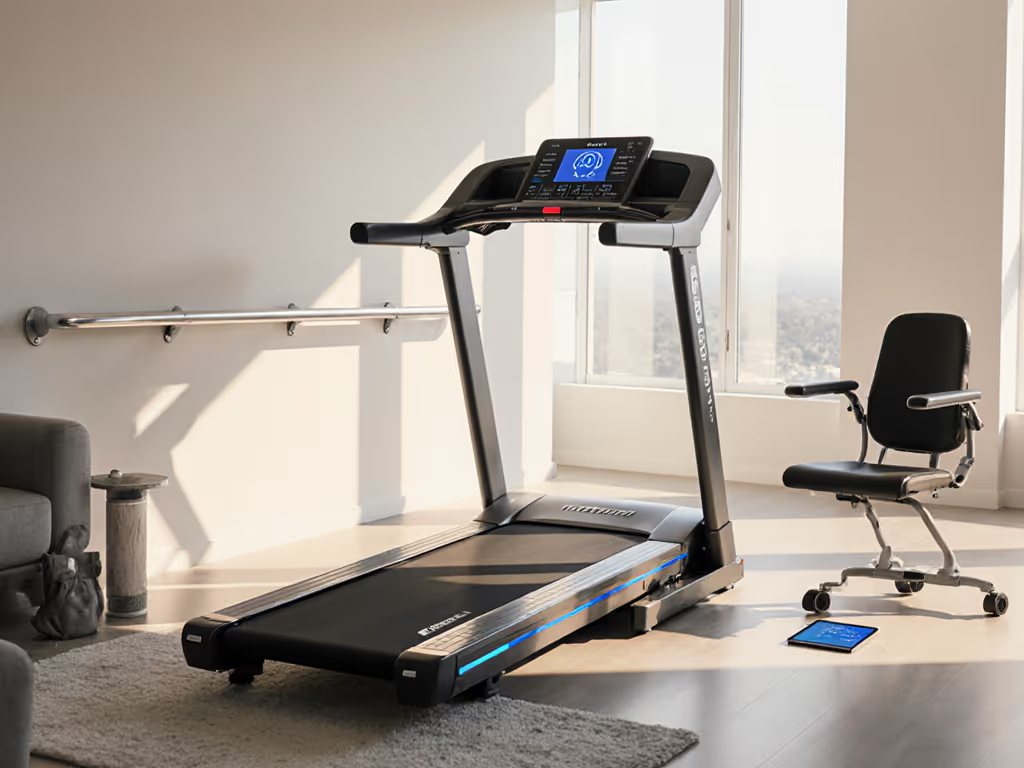
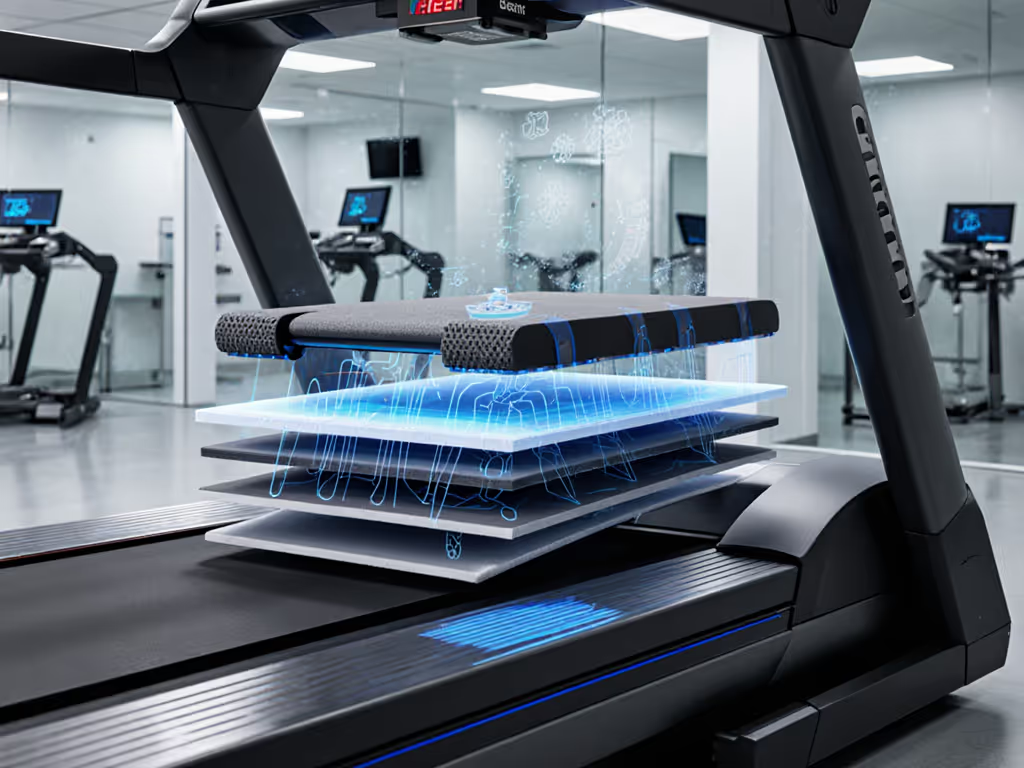
High. Users with balance disorders, proprioceptive issues, or lower-limb weakness depend on a rock-solid deck and handrails. Wobble, lateral flex, or excessive vibration introduces instability that forces compensatory movements, precisely what adaptive programming tries to prevent. If balance support is a priority, compare models with extended rails and low-speed stability in our accessible treadmills comparison. A deck that rocks at 4 mph will force a user to tense their core unnaturally or grip rails too hard, altering their gait and undermining the workout's therapeutic intent.
Stability also connects to multi-user households: if different users have different weights and gait patterns, the machine must handle that variability without degradation. Many home treadmills spec "maximum user weight" but don't publish how deck drift or belt slippage changes across the weight range.
Why does subscription lock matter for adaptive users?
Adaptive users often benefit from offline, no-pressure access: pausing mid-workout without losing data, repeating a phase without internet, or simply having the machine function during connectivity gaps. Some subscription platforms require a sign-in for every session, use paywall models that lock basic features (like saved workouts or heart-rate capture) behind tier upgrades, or disable the treadmill's core functions (like manual control of speed) if the app is unavailable.
For someone managing fatigue, anxiety, or unpredictable pain days, forced-connectivity and feature lock-in become barriers, not enablers. Truly inclusive design keeps the hardware functional and useful even if the subscription is inactive. We benchmark platform lock-in and offline options in our adaptive subscription access comparison.
How do platforms compare on accessibility for sensory or motor diversity?
Variance is high, and few platforms publish transparent comparisons. Common adaptive features include:
- Voice cuing and haptic feedback: helpful for visually impaired users or those who benefit from auditory rhythm. Rarely tested for clarity or accuracy.
- Large-display or high-contrast console options: critical for low-vision users. Most subscriptions assume a smartphone app, which is inaccessible if the app lacks proper contrast or resizing.
- One-hand or foot-pedal controls: rarely offered; most assume dexterous hand use for console or app.
- Customizable difficulty segmentation: quality platforms segment by movement quality (e.g., "good ankle mobility," "limited knee flexion") rather than generic "beginner/intermediate/advanced." Few do this.
- Slow-speed precision: most home treadmills perform poorly below 2 mph, precisely where rehab and balance work often live. Subscription platforms rarely acknowledge this.
The gap is real: most platforms claim inclusivity but offer generic features applied to hardware not optimized for adaptive use.
What sustainability and serviceability factors affect long-term inclusive use?
An adaptive user often depends on a treadmill longer and more frequently than a casual exerciser. If the machine fails, repair time matters acutely (interrupting a rehab protocol can set recovery back weeks). Long-term inclusive support includes:
- Spare-parts availability: Can you replace a worn belt, motor coupling, or handrail grip in under a week? Or does it require a proprietary part and a 6-week lead time?
- Subscription portability: If the hardware vendor discontinues support or the subscription platform pivots, can your data and workouts transfer to another platform?
- Warranty coverage: Does the warranty cover high-use scenarios (daily use, multi-user load, or heavier users)?
- Service-network density: For someone with mobility limitations, can they access service locally, or must they mail the device?
Most home treadmill subscriptions don't address these; they focus on year-one acquisition, not five-year reliability. Before you commit, review our cross-brand treadmill warranty comparison to understand real coverage and service networks.
The Method: What to Test Before Subscribing
1. Speed and Incline Verification
Don't trust the console. If the platform or hardware vendor hasn't published third-party verified speed and incline data, run your own check. Use a phone's slow-motion video camera to count belt revolutions, measure actual belt length, and back-calculate speed. For incline, use a digital level on the deck surface. It takes 10 minutes and reveals whether the hardware is fit for adaptive programming.
2. Deck Stability at Your Weight and Gait
Run or walk at your typical speeds on a demo unit (if available) or during a trial. Do the handrails flex? Does the deck flex laterally? Does belt slip happen at speed ramps or during direction changes? Film it; instability often appears on video before you consciously feel it.
3. Offline Functionality
Disconnect the internet or log out of the app. Can you still start the treadmill, manually set speed and incline, and run for 30 minutes? If not, that's a red flag for adaptive users who may have unpredictable internet or who value autonomy from app dependency.
4. Accessibility Feature Depth, Not Breadth
Ask the platform: "Show me three real workouts designed for users with limited ankle mobility" or "How does the app adjust if a user can't see the screen?" Generic features sound inclusive; tested, specific workflows prove it.
5. Repair Ecology
Email the company's support team with a concrete question: "If the motor fails in month 8, what's the typical repair timeline and cost outside warranty?" Their answer speed and specificity reveal whether they're built for adaptive longevity.
Putting It Together: A Comparison Framework
When evaluating adaptive workout programming treadmill options, prioritize in this order:
- Hardware: verified speed/incline accuracy and deck stability (non-negotiable; affects safety and efficacy)
- Offline core functionality (emergency access and autonomy)
- Subscription transparency (what features are hardware-gated vs. paywall-gated?)
- Serviceability and warranty scope (long-term viability)
- Accessibility depth (tested, specific features, not checkboxes)
- Ecosystem sustainability (can your data survive a platform pivot?)
A platform that nails #1-4 but has generic accessibility features is more trustworthy than one with a flashy accessibility section built on shaky hardware.
Summary and Final Verdict
Adaptive treadmill subscriptions are still maturing. Most platforms conflate "having accessibility features" with "being accessible," and they rarely disclose the verified performance baselines that make inclusive programming safe. The market has adopted the language of inclusivity faster than the engineering discipline.
For adaptive users (those training through rehab, managing joint conditions, or navigating sensory or motor diversity), the treadmill is not a luxury or entertainment device. It's a tool with narrow performance requirements. That means the subscription platform you choose must start with hardware that's been verified for speed, incline, and stability. Without that foundation, no amount of user-profile customization or voice cuing bridges the gap.
Your next steps: (1) Identify the specific adaptive need (e.g., arthritis-safe speed range, balance support, post-surgery progression). (2) Demand third-party verified specs for speed and incline from any platform's hardware partner. (3) Run a trial that includes an offline session (if the machine won't function offline, it's not adaptive for you). (4) Ask support one concrete, hard question about repair timelines. Their answer tells you whether they're serious about long-term inclusive support.
Speed is a promise; we verify it, millimeter by millimeter. The same rigor applies to inclusive fitness. Choose the platform that's willing to show its work, not just its claims.
Related Articles
Treadmill Comparisons
Astrophotography Treadmill Setups: Verified Stability & Noise
11th Mar•9 min read